There's a gap in your company's defenses that's still easy to close today. This isn't an argument for panic — it's an argument for understanding what happens to that gap the longer you leave it open.
Exposure Isn't Static
Most leadership teams think about security gaps as a one-time state: either you're vulnerable, or you're not. That framing misses what's actually happening.
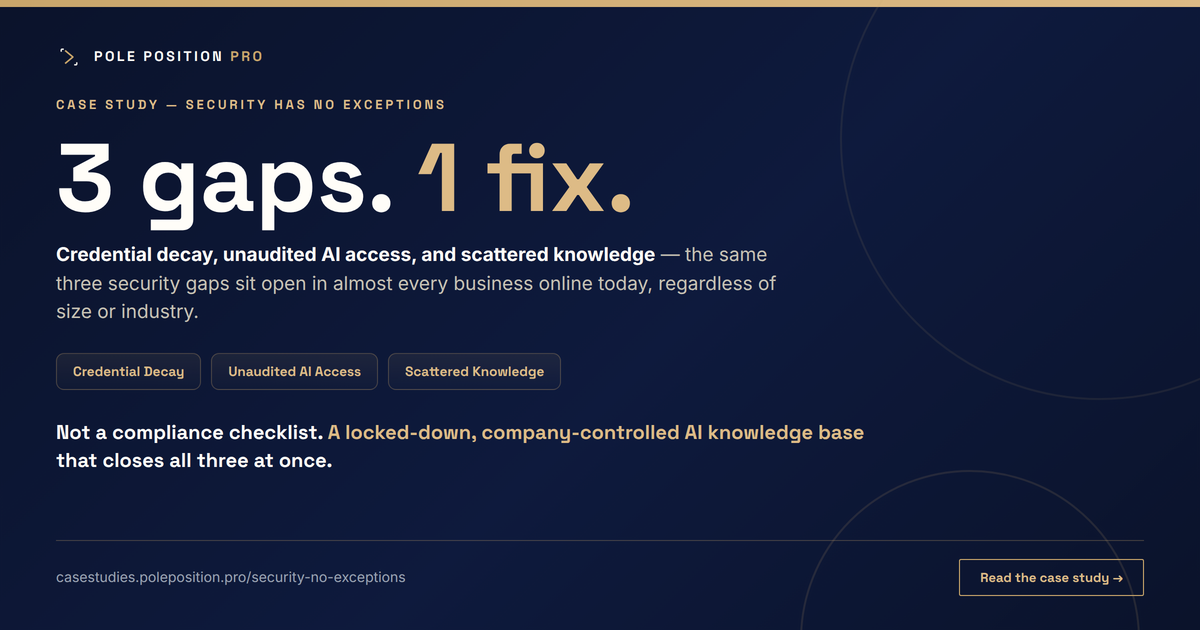
In one thoroughly documented pattern, three specific gaps sit open in almost every business online today, regardless of size or industry: credential decay, unaudited AI access, and scattered knowledge. None of them exist because a company is doing something wrong. All three grow because the world around them is changing — more computing power, more AI integrations, more unmanaged tools.
That distinction is the whole point. A static risk is an isolated state you assess once and move on. A growing exposure widens every month — and that's the part most people don't account for.
What Compounding Exposure Looks Like in Practice
Take credential decay. Combined computing power keeps growing, and that keeps shrinking how long any password holds up. What took weeks to crack a few months ago now takes hours. That process doesn't stop — and every month spent on an aging authentication setup narrows your safety margin a little further.
The same is true of unaudited AI access. Maybe today it's one or two chatbots or automations connected to real company systems with no review. But every new tool adopted without bringing that surface under control widens the point where something can go wrong.
Scattered knowledge isn't a one-time state either. Company data keeps spreading across more public AI tools and unmanaged integrations until there's no single place left where anyone has a full picture of what lives where and who can reach it.
Today, these gaps might still be theoretical risks. Six months from now, with another quarter of expansion behind them, they can be concrete, exploitable entry points.
Why "Later" Isn't the Safe Choice It Feels Like
To be fair: waiting isn't the same as being irresponsible. A company might genuinely have other priorities right now, or isn't ready to commit yet. That's a legitimate call.
What's worth thinking through deliberately: today, you're still the one deciding how large a surface you'll eventually have to close, and on what timeline. That control — over the scope and timing of the fix — is exactly what erodes over time.
Because past a certain point, once the gap has grown wide enough, closing it stops being prevention. It becomes damage control — rushed, more expensive, and often happening after an actual incident rather than before one.
For today's automated, indiscriminate attacks, the only qualifying criterion is being reachable online. "Too small to be a target" stopped being a safe assumption. And the old defense — trust anyone "inside the network" — doesn't hold up anymore once work happens from anywhere and every app lives in the cloud.
What This Means for Your Business
This isn't an argument for dropping everything and launching a full security overhaul overnight. It's an argument for deciding deliberately — while the gaps are still a manageable size, not after they've already been exploited.
The case study behind this shows exactly how all three gaps close with a single, locked-down, company-controlled AI knowledge base, built on Zero Trust principles: the full architecture, the 90-day rollout plan, and a live, interactive dashboard where you can see exactly where your defenses stand today.
Curious how exposed your own business actually is right now — and what closing these gaps today, instead of putting it off again, would look like? Take the free AI audit.